
PM10 and PM2.5: What Is the Difference Between Particulate Matter and Fine Particles?

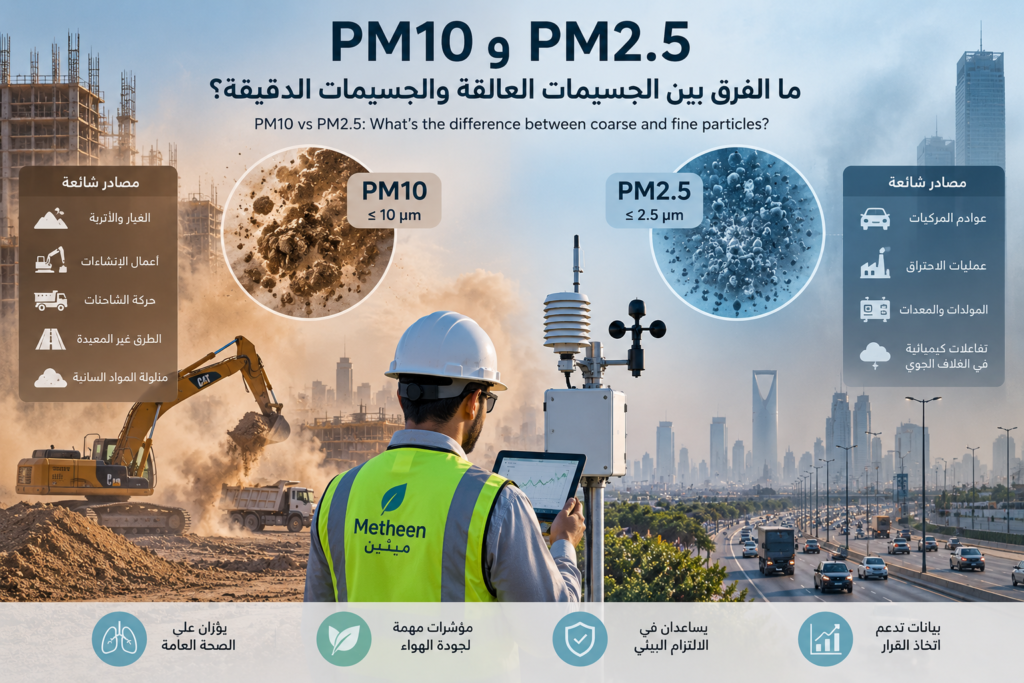
Particulate matter is one of the most important indicators used to assess air quality. Among the most commonly monitored parameters are PM10 and PM2.5. Although both refer to particles suspended in the air, their difference in size gives them different characteristics, sources, and environmental significance.
Monitoring these particles is particularly important in Saudi Arabia, where their levels can be influenced by natural factors such as dust and sandstorms, as well as industrial and construction activities, vehicle traffic, and combustion processes.
What Do PM10 and PM2.5 Mean?
The abbreviation PM stands for Particulate Matter, referring to solid and liquid particles suspended in the atmosphere.
The number indicates the aerodynamic diameter of the particles:
- PM10: Particles with an aerodynamic diameter of 10 micrometers or less.
- PM2.5: Fine particles with an aerodynamic diameter of 2.5 micrometers or less.
Therefore, PM2.5 represents a smaller fraction within the broader PM10 size range rather than being a completely separate type of particulate matter.
What Is the Difference Between PM10 and PM2.5?
| Parameter | PM10 | PM2.5 |
|---|---|---|
| Particle size | 10 micrometers or less | 2.5 micrometers or less |
| Particle type | Inhalable particulate matter | Very fine particulate matter |
| Common sources | Dust, excavation, construction, roads, soil, and some industrial activities | Combustion, vehicle exhaust, generators, industrial processes, and atmospheric reactions |
| Environmental monitoring | Important for monitoring dust and suspended particles | Important for monitoring fine particles that can penetrate deeper into the respiratory system |
Why Does Particle Size Matter?
Particle size affects how particles move and remain suspended in the atmosphere, as well as how deeply they may penetrate the respiratory system when inhaled.
Larger particles, including a significant portion of PM10, are commonly associated with dust, soil, construction activities, and material handling. Smaller particles such as PM2.5 can remain airborne for longer periods under certain conditions and can penetrate deeper into the respiratory system.
For this reason, measuring PM10 alone does not necessarily provide a complete picture of fine particulate pollution, while monitoring PM2.5 does not eliminate the importance of PM10, particularly in environments affected by dust and construction activities.
What Are the Main Sources of PM10?
PM10 can originate from a wide range of activities and environmental sources, including:
- Excavation and earthworks.
- Demolition and construction activities.
- Heavy truck and equipment movement.
- Storage and handling of bulk materials.
- Quarries and crushing operations.
- Unpaved roads.
- Dust from exposed surfaces.
- Certain industrial processes.
For this reason, PM10 is an important indicator when assessing dust generated by construction projects and industrial activities.
What Are the Main Sources of PM2.5?
PM2.5 is more strongly associated with combustion and processes that generate very fine particles. Potential sources include:
- Vehicle exhaust.
- Generators and combustion-powered equipment.
- Boilers and furnaces.
- Certain industrial processes.
- Fuel and material combustion.
- Secondary particles formed through chemical reactions in the atmosphere.
The actual sources of PM2.5 at a specific location depend on the site’s activities, processes, emission sources, and surrounding environmental conditions.
Is PM2.5 More Harmful Than PM10?
It is not appropriate to simply describe one as universally “more harmful” than the other, because potential impacts depend on factors such as concentration, duration of exposure, particle composition, source, and environmental conditions.
However, because PM2.5 particles are significantly smaller, they can penetrate deeper into the respiratory system when inhaled and therefore receive particular attention in air quality monitoring programs.
PM10 remains an important indicator, especially in environments affected by dust, construction, road activity, and material handling.
Why Is PM10 and PM2.5 Monitoring Important for Construction Projects?
Construction projects can generate significant amounts of dust and particulate matter through excavation, demolition, material transportation, and heavy equipment movement.
Monitoring PM10 and PM2.5 can help projects:
- Track changes in particulate concentrations.
- Evaluate the effectiveness of dust-control measures.
- Identify unusual increases in particle levels.
- Correlate particulate concentrations with activities taking place on site.
- Support corrective and preventive actions.
- Provide reliable data for the project’s environmental management program.
Saudi Arabia has placed increasing emphasis on dust control and air quality monitoring in construction projects. The National Center for Environmental Compliance has announced specific requirements for controlling construction-generated dust in certain projects in Riyadh, including the use of air quality monitoring equipment and connection to the unified dust-monitoring platform within the applicable scope.
Why Is PM10 and PM2.5 Monitoring Important for Industrial Facilities?
In industrial facilities, particulate matter can originate from production processes, combustion activities, material handling, and various emission sources.
Monitoring PM10 and PM2.5 helps provide a clearer picture of ambient air quality around the facility. It can also support the evaluation of emission-control systems and help identify unusual trends.
The National Center for Environmental Compliance has indicated that the national air quality monitoring network tracks several air quality parameters, including PM10 and PM2.5, as well as nitrogen oxides, ozone, carbon monoxide, and sulfur dioxide.
Is Measuring PM10 Without PM2.5 Sufficient?
Not necessarily.
The appropriate monitoring parameters depend on the nature of the activity, emission sources, location, environmental permit conditions, and applicable technical and regulatory requirements.
At some sites, PM10 may be particularly important because of dust sources, while PM2.5 may be more closely associated with combustion sources. In other cases, monitoring both parameters may provide a more comprehensive understanding of particulate pollution.
The monitoring program should therefore be based on an assessment of the actual pollution sources rather than on a standardized list that is assumed to apply to every project.
How Are PM10 and PM2.5 Monitored?
Specialized instruments and monitoring systems are used to measure particulate concentrations in the air. The appropriate technology should be selected according to the objectives of the monitoring program and applicable technical and regulatory requirements.
The quality of monitoring results does not depend on the instrument alone. It also depends on:
- Proper selection of the monitoring location.
- Instrument calibration and verification.
- Routine maintenance.
- Data quality assurance.
- Recording relevant meteorological conditions.
- Documenting measurement and maintenance activities.
- Analyzing data and identifying abnormal readings.
Why Is Monitoring Data Important for Environmental Decision-Making?
The value of monitoring is not simply knowing the PM10 or PM2.5 concentration. The real value lies in understanding when and why concentrations increase.
When elevated particulate levels are detected, monitoring data can be compared with truck movement, excavation activities, wind direction, weather conditions, industrial operations, and other factors to help identify potential causes and determine appropriate actions.
This makes environmental monitoring a practical tool for improving environmental performance rather than merely a data-recording exercise.
Metheen Limited’s Role in Particulate Matter Monitoring
Metheen Limited provides environmental monitoring and measurement services for projects and facilities, including particulate matter and ambient air quality monitoring based on the nature of the activity and applicable environmental requirements.
Our monitoring services include:
- PM10 monitoring.
- PM2.5 monitoring.
- Ambient air quality monitoring.
- Environmental gas measurements according to the nature of the activity.
- Stationary source emission testing.
- Environmental compliance support.
- Environmental studies and consulting.
A properly structured monitoring program provides reliable data that can help facilities and projects understand particulate sources, assess air quality, improve control measures, and reduce pollution risks.
Frequently Asked Questions
What does PM10 mean?
PM10 refers to particulate matter with an aerodynamic diameter of 10 micrometers or less.
What does PM2.5 mean?
PM2.5 refers to fine particulate matter with an aerodynamic diameter of 2.5 micrometers or less. It represents a smaller fraction within the PM10 size range.
What is the main difference between PM10 and PM2.5?
The primary difference is particle size. PM2.5 particles are much smaller than PM10 particles and can penetrate deeper into the respiratory system when inhaled.
Does dust affect PM10 levels?
Yes. Dust, soil, excavation, construction activities, and vehicle movement on unpaved surfaces can all contribute to PM10 concentrations.
Does every facility need to monitor PM10 and PM2.5?
A single monitoring requirement cannot be applied to every facility. The appropriate monitoring scope depends on the activity, emission sources, location, environmental permit conditions, and applicable technical and regulatory requirements.
Conclusion
Both PM10 and PM2.5 are important indicators for understanding air quality. However, their difference in particle size means that they provide complementary information within an environmental monitoring program.
PM10 is particularly important in environments affected by dust, construction, and material handling, while PM2.5 is more closely associated with fine particles generated by combustion, certain industrial processes, and other sources.
By selecting appropriate monitoring parameters, carefully determining monitoring locations, and maintaining proper calibration, maintenance, and data-quality procedures, projects and facilities can use PM10 and PM2.5 monitoring to improve air quality management, control pollution sources, and support compliance with environmental requirements in Saudi Arabia.
SEO Information
Meta Title: PM10 and PM2.5: Difference Between Particulate and Fine Particles
Meta Description: Learn the difference between PM10 and PM2.5, their main sources, and why monitoring particulate matter is important for industrial and construction projects in Saudi Arabia.
Focus Keyword: PM10 and PM2.5
Secondary Keywords:
- Particulate Matter
- Fine Particles
- PM10 Monitoring
- PM2.5 Monitoring
- Air Quality Monitoring
- Air Pollution in Saudi Arabia
- Dust Monitoring
- Environmental Monitoring in Saudi Arabia
- Air Quality in Construction Projects
- Air Quality in Industrial Facilities
Official References
- Executive Regulation for Air Quality under the Environmental Law – Umm Al-Qura Official Gazette.
- National Center for Environmental Compliance (NCEC).
- Official information concerning the national air quality monitoring network in Saudi Arabia.
- Applicable environmental requirements related to dust and air quality monitoring.
